
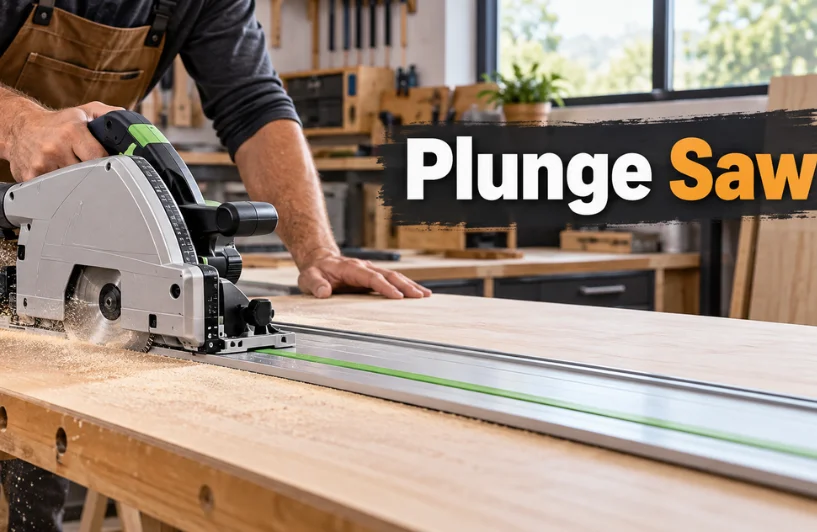

Choosing a plunge saw is about buying a cutting system that suits your work. It uses a circular blade that lowers into material while a guide rail keeps the cut straight. Motor power matters, but it should not dominate your decision. UK buyers should also check whether rails and batteries match tools they already own.
| Key points about Plunge Saw | What to look for |
|---|---|
| Best uses | Sheet materials, doors, worktops, flooring, cabinetry |
| Main accuracy aid | A compatible guide rail with a clean splinter strip |
| Common blade size | Around 160–165mm on many popular UK models |
| Power choice | Corded for fixed work; cordless for mobile fitting |
| Cutting depth | Check the specification while the tool is on its rail. |
| Dust control | Enclosed blade housing plus effective extraction |
| Buying trap | Assuming guide rails from different systems will fit |
Quick answer
This rail-guided power saw makes controlled, straight cuts with a blade that lowers into the material. It can start cuts away from an edge. UK buyers should check rail compatibility, cutting depth, blade choice, and power source. Dust extraction and included accessories also affect value.
Key takeaways
- Choose the rail system before comparing small convenience features.
- Check cutting depth on the rail, not only the headline maximum.
- Compare complete kit cost, including rails, clamps, batteries, blades, and extraction accessories.
- Pick corded, cordless, or hire based on where and how often you cut.
What a track saw does better than a circular saw.
A track saw rides on a guide rail, which controls the cutting line from start to finish. Its enclosed blade lowers only when you press the tool into the workpiece. This design allows controlled entry cuts, long rips, and accurate trimming on finished panels. A standard circular saw is faster to set up for rough cutting and framing work. It can also be cheaper if you already own a reliable model.
A rail-guided tool becomes more useful when edge quality, repeatability, and dust control matter.
| Task or feature | Track saw | Standard circular saw |
|---|---|---|
| Long straight panel cuts | Strong fit because the rail guides the cut | Possible with a separate straightedge or rail |
| Starting inside a panel | Designed for controlled plunge entry | Usually awkward or unsuitable |
| Rough framing cuts | Capable, but often slower to set up | Usually quicker and simpler |
| Dust collection | Enclosed design often helps extraction. | A more open blade area can release more dust. |
| Repeatable finished edges | Strong when the rail is set correctly | Depends more on guides and operator control |
How to choose a plunge saw in the UK
Start with the jobs you expect to do, then work backwards from those requirements. Rail length, material thickness, and working location quickly narrow the options. The following eight checks cover the features that matter most for UK buyers.
1. Choose the guide rail system before the motor.
Guide rails are not universally interchangeable, even when their aluminum profiles look similar. Festool-pattern rails are shared across several brands, while Bosch and Mafell use another common system. DeWalt and some other makers use proprietary arrangements, so confirm compatibility before buying accessories.
2. Match rail length to your projects.
A 1.4–1.5 meter rail handles many door trims, worktop crosscuts, and medium panel jobs. Full-sheet ripping often needs a longer rail or two sections joined accurately. Buy enough overrun for the saw to sit securely before and after the cut.
3. Check blade size and cutting depth.
Many popular UK models use blades around 160–165mm, which suit common sheet materials and joinery work. Check the stated cutting depth while the saw is mounted on its rail. Bevel cuts reduce available depth, so compare the angled specification too.
4. Decide between corded and cordless power.
Corded models offer continuous power and usually make sense in a fixed workshop. Cordless models suit site work, room-to-room fitting, and places where cables become awkward. Battery compatibility can matter more than headline voltage if you already own one tool platform.
5. Take dust extraction seriously.
Wood dust deserves more attention than many buying guides give it. HSE advises effective extraction when wood is machined and highlights risks from MDF and other wood dusts. Choose a secure extractor port, a good blade enclosure, and a suitable vacuum connection. For longer dusty work, HSE also gives guidance on suitable respiratory protection.
6. Look for useful accuracy and control features.
Look for clear depth settings, smooth plunge action, and easy bevel adjustment. A scoring setting can help on delicate laminates, while a splinter strip supports cleaner visible edges. Anti-kickback features and an electronic brake can also improve control on suitable models.
7. Check what the kit actually includes.
Check whether the box includes the rail, joining bars, clamps, blade, case, batteries, and charger. A cheap bare tool can become expensive once you add those extras. Compare the complete working setup, not just the saw body.
8. Think about lifetime system cost.
Replacement blades, extra rails, extraction hoses, batteries, and storage all affect ownership cost. A one-off kitchen job may justify hiring instead of buying. Regular renovators gain more value from a system that can expand with future projects. If you are building a permanent cutting area, plan storage and dust control alongside the tool itself.
Trendara’s workshop tools guide covers broader workshop planning and complementary equipment. A stable support surface will also make long cuts easier to control.
Corded, cordless, or hire: which option fits your work?
| Option | Best for | Advantages | Trade-offs |
|---|---|---|---|
| Corded | Workshops and frequent home renovation | Continuous power, simpler ownership, no charging | Cable management and mains access |
| Cordless | Mobile fitting and site work | Easy movement, fewer trailing cables, battery-system convenience | Battery cost, charging, and runtime planning |
| Hire | One-off worktops, doors, or short projects | Access to a complete system without long-term ownership | Collection time, availability, and limited practice time |
Recommendation by use case
For most home renovators starting from scratch, we recommend a corded kit with a suitable rail. Choose cordless when mobility matters, or you already have compatible batteries in your toolbox. Hiring can be smarter for one expensive worktop cut or a short project. Trade users should prioritize rail availability, spare parts, batteries, and extraction compatibility before cosmetic features.
A familiar system reduces setup friction across repeated jobs. The right choice fits both your work pattern and existing equipment.
Cut quality depends as much on setup as on the tool.
Calibrate a new rail’s splinter strip before using it on visible material. Use a sacrificial board and follow the manufacturer’s setup instructions. Once trimmed to the blade path, the strip becomes a reliable cut-line reference. Use a sharp blade with a suitable tooth count for the material, rather than forcing one blade through every job.
Fine-finish blades help on veneered boards and laminates, while faster blades suit rougher cuts. Test on scrap before committing to an expensive worktop or finished panel. Support large sheets across their full area so the offcut cannot sag or pinch the blade. Set cutting depth only slightly beyond the material, following the manufacturer’s guidance. Keep the rail clean, as debris can affect grip and alignment.
Dust, safety, and working habits
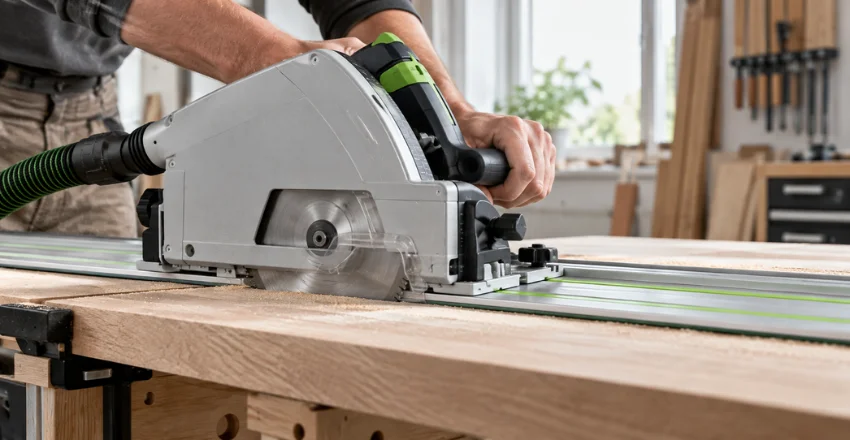
Connect extraction before cutting MDF, plywood, or timber indoors. HSE says wood dust can cause respiratory problems and recommends extraction as a primary control. You may also need suitable respiratory protection for dusty or extended work. Keep hands clear of the blade path and wait for the blade to stop before lifting the tool. Disconnect power or remove the battery before changing blades or clearing trapped material.
Clamp the rail when movement could spoil the cut or create a hazard. For broader project safety, plan the whole workspace rather than focusing only on the saw. Trendara’s construction-site HSE guide covers planning, equipment checks, and practical controls. DIY users should still read the tool manufacturer’s instructions before starting.
If a task involves expensive finished materials, uncertainty can cost more than professional help. Trendara’s handyman services guide explains when specialist support can save time or prevent damage. This matters most when a single bad cut could ruin a worktop or door.
Final buying checklist
Before buying, write down your longest cut, thickest material, usual location, and existing battery system. Then choose the rail family before comparing smaller features. This simple order prevents many expensive compatibility mistakes.
- Confirm the saw and rail are compatible.
- Choose enough rail length for your longest regular cut.
- Check cutting depth while the tool is mounted on its rail.
- Match the blade to the materials you cut most.
- Confirm your extractor or hose fits the dust port.
- Compare complete kit contents, not the body price alone.
- Check that replacement blades, rails, clamps, and batteries are easy to source.
- Read the manufacturer’s safety and setup instructions before first use.
Shortlist two or three complete systems and compare their total cost with the accessories you need. If you already own rails or batteries, compatibility may decide the choice quickly. Once the system fits your projects, focus on blade quality, setup accuracy, and safe cutting habits.
Frequently asked questions
Is a plunge saw worth buying for DIY?
It can be worthwhile if you regularly cut sheet materials, doors, flooring, or worktops. The rail makes long straight cuts easier to repeat than freehand cutting. For one small project, hiring may make more financial sense.
Can a track saw be used without a guide rail?
Some models can cut without a rail, but you lose the main accuracy advantage. Manufacturer instructions vary, so check whether freehand use is supported. For finished work, using the correct rail is usually the safer approach.
Are all guide rails compatible?
No. Rail profiles differ between systems, and similar-looking tracks can still fit differently. Confirm the exact saw and rail combination before buying or borrowing accessories.
What blade is suitable for MDF and laminate?
A sharp fine-finish blade generally gives a cleaner edge on MDF, veneered boards, and laminate surfaces. Tooth count and blade geometry must still match the saw and material. Use extraction because fine board dust can spread quickly.
Should I buy corded or cordless?
Choose corded for frequent workshop cutting with reliable mains access. Choose cordless for fitting work, mobile jobs, or an existing battery platform. Compare the whole kit cost, not the bare tool price.