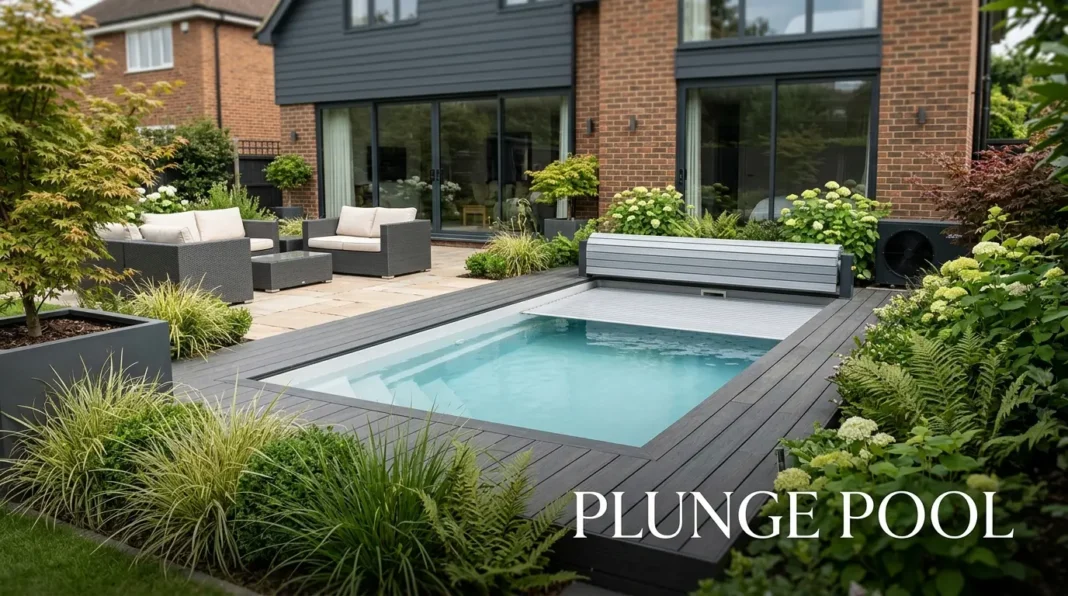

A plunge pool is a compact, relatively deep pool designed for cooling off, soaking and gentle movement rather than swimming lengths. For UK homeowners, its smaller footprint can make it practical where a conventional swimming pool would dominate the garden. Costs vary considerably depending on construction, heating, access, and landscaping.
A plunge pool can bring the feel of a private spa or boutique hotel into a surprisingly modest garden, but its appeal goes beyond appearance. Unlike a full-size swimming pool, it is designed around immersion, relaxation, and cooling rather than lap swimming, so the footprint can be much smaller. That makes the format particularly interesting for British homeowners who want an outdoor water feature without sacrificing most of their lawn, terrace or entertaining space.
The key is choosing the right type rather than simply picking the smallest pool available. Heating, insulation, filtration, access, ground conditions and planning restrictions can make two pools of similar dimensions very different projects. Before committing, treat the pool as part of the whole garden design rather than a product dropped into an empty corner.
What Is a Plunge Pool?
A plunge pool is essentially a compact swimming pool intended mainly for standing, sitting, cooling down, and relaxing in the water. UK examples commonly range from 2.4–4.5 metres in length, although there is no single standard size and considerably smaller designs are available. Depth is often around 1.2–2 metres, giving more usable immersion than a shallow paddling pool without requiring the length of a conventional swimming pool.
You can install it in the ground, partially sunk, or above ground as a self-contained unit. Some owners keep the water cool for summer use or deliberate cold-water immersion, while others add heating so the pool remains comfortable across more of the year. Features such as bench seating, lighting, covers, jets and automated filtration can make the finished installation feel closer to a compact private spa.
Why These Compact Pools Appeal in UK Gardens
Space is one of the biggest reasons homeowners consider this type of pool. A compact design can create a genuine water feature without requiring the long footprint necessary for swimming lengths, and recent UK garden coverage has highlighted these compact pools as an increasingly realistic option for smaller gardens. The pool can therefore become one zone within the garden rather than consuming the entire outdoor space.
This approach fits naturally with a broader move towards making limited space work harder. If that is part of your renovation strategy, Trendara’s guide to why living small is the new living large explores the wider idea of getting more value and functionality from a smaller footprint. A pool still needs room for circulation, servicing and safe access, but thoughtful sizing can preserve space for planting, seating and outdoor dining.
Compact Pools at a Glance
| Factor | Typical consideration |
|---|---|
| Main use | Cooling, soaking, relaxation and gentle exercise |
| Typical length | Around 2.4–4.5m, with smaller and larger models available |
| Typical depth | Around 1.2–2m |
| Installation | Above ground, partially sunk or fully in ground |
| Temperature | Cold, ambient or heated |
| Best suited to | Smaller gardens, courtyards and wellness-focused spaces |
| Main limitation | Usually too short for conventional lap swimming |
| Major cost drivers | Shell, excavation, groundwork, access, electrics, heating and landscaping |
Treat dimensions as typical ranges rather than rules, because suppliers use the term differently. Some compact products sit close to the boundary between a plunge pool, cold-plunge tub and small swimming pool. Your intended use should therefore determine the dimensions before appearance or optional features do.
How Much Does a Plunge Pool Cost in the UK?
A professionally installed pool is a significant home-improvement project, and the advertised shell price rarely tells the whole story. One 2026 UK guide places installed above-ground modular pools at roughly £8,000–£15,000, while in-ground concrete or stainless-steel installations can reach approximately £20,000–£35,000 or more. Other current UK estimates put the broader market at roughly £10,000–£35,000, while premium bespoke projects can climb substantially higher.
The final figure depends heavily on what happens around the pool. Excavation, spoil removal, foundations, crane access, drainage, electrical work, filtration, heating, paving, fencing and landscaping can all add to the total. This is why comparing two headline pool prices without comparing the complete installation specification can give a misleading picture of value.
| Project type | Indicative 2026 UK range | What usually affects the price |
|---|---|---|
| Basic cold-plunge setup | From hundreds to several thousand pounds | Tub construction, insulation, chiller and filtration |
| Modular/above-ground pool | Around £8,000–£15,000 installed | Base, access, electrics and optional heating |
| In-ground pool | Around £20,000–£35,000+ | Excavation, structure, plumbing and finishes |
| Premium bespoke project | £35,000+ and potentially much higher | Custom structure, difficult access, landscaping and luxury equipment |
A cheap cold-plunge tub shouldn’t automatically be compared with a permanent landscaped pool because they offer very different experiences. Current UK cold-plunge pricing ranges from simple unchilled tubs costing a few hundred pounds to premium chilled systems costing thousands, whereas a permanent pool adds structural and landscaping work. Decide first whether you want cold-immersion equipment or a long-term garden feature, then compare products within the right category.
What Size Works in a Small Garden?
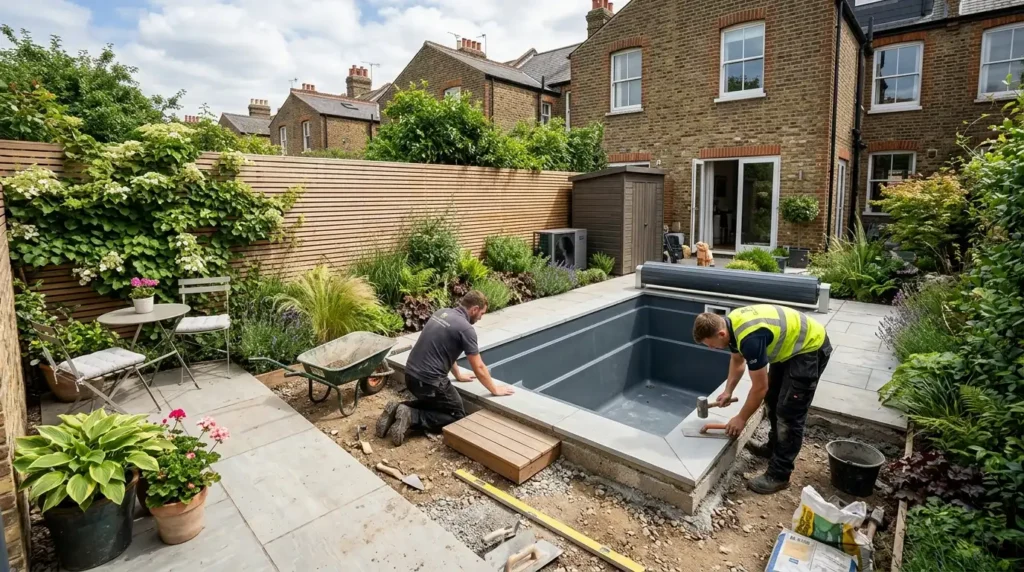
Start by measuring the usable garden, not the total plot. A 3m pool does not need only 3m of space because you also need safe entry, circulation, access to equipment and enough room for maintenance. A beautifully proportioned smaller pool with usable space around it will generally work better than the largest shell that can technically be squeezed between two boundaries.
Access to the garden also matters before you order anything. A one-piece shell may need to pass through a side entrance or be lifted into position by a crane, while concrete construction can require machinery and repeated access for materials. Ask the supplier to assess the delivery route, overhead cables, gates, neighbouring property and working space before the contract becomes non-refundable.
The weight of the filled pool is another important consideration, particularly for raised patios and decking. One litre of water weighs approximately one kilogram, so several thousand litres quickly become several tonnes before the weight of the shell, finishes and users is added. Never assume existing decking or a lightweight terrace can support a filled pool without an appropriate structural assessment.
In-Ground or Above-Ground: Which Is Better?
An in-ground design usually offers the most integrated appearance because paving or decking can run almost level with the water. It can look like part of the original landscape design rather than additional equipment placed in the garden. The trade-off is excavation, construction work, longer installation, and a larger budget.
An above-ground or modular build can reduce excavation and may be much quicker to install. It is often attractive where access is reasonable, and homeowners want the flexibility of a self-contained system rather than a substantial concrete build. Careful cladding, planting and steps can help a raised pool feel intentional rather than temporary.
A partially recessed pool sits between the two approaches and can be useful on sloping sites. Part of the shell remains accessible for servicing while the visible side can be integrated into decking, paving or retaining walls. The correct solution depends on drainage, levels, soil conditions and the structural design of the surrounding landscape.
Cold Water or Heated Water?
A cold plunge is designed around deliberate cold-water immersion and usually prioritises insulation, filtration and temperature control. That can suit people building a sauna-and-cold-plunge area or those who specifically want a cold-water routine. However, treat cold-water immersion as a genuine physiological stressor rather than just another luxury garden feature.
The RNLI classifies water at 15°C and below as cold water and warns that sudden immersion can affect breathing, movement, heart rate and blood pressure. People should acclimatise carefully rather than jump unexpectedly into very cold water, and anyone with a relevant medical condition should seek professional advice before starting deliberate cold immersion. Cold-plunge marketing claims should never replace basic water-safety precautions.
A heated pool serves a different purpose because comfort and longer seasonal use take priority. Heating can make a compact garden pool much more appealing on cooler spring and autumn days, although it also increases energy consumption. Good insulation and a well-fitted cover are therefore especially important if you want to maintain a warmer water temperature.
Do You Need Planning Permission in the UK?
You need to check planning rules for the specific property because there is no single UK-wide answer that covers every home. In England, an outdoor domestic swimming pool can often fall within permitted development rights when it is incidental to the enjoyment of the house and complies with the relevant limits and conditions. The Planning Portal nevertheless advises homeowners to check local restrictions before starting work.
Restrictions become more important around listed buildings and designated land. Government guidance states that a pool within the land surrounding a listed building does not receive the same Class E permitted-development right, and additional limitations can apply in conservation areas, National Parks, Areas of Outstanding Natural Beauty, and other protected locations. A raised platform, major pool house or other associated structure can also introduce separate planning considerations.
Rules and terminology differ across England, Wales, Scotland and Northern Ireland, so a UK homeowner should confirm the position with the relevant local authority rather than assuming English planning rules apply everywhere. Planning permission and Building Regulations are separate systems, so not needing one does not automatically remove every requirement under the other. Where the project includes significant electrical, structural or building work, confirm the applicable requirements before construction starts.
Electrics, Drainage and Groundwork Need Proper Planning
A pool combines water and electrical equipment, so pumps, heaters, chillers and lighting are not areas for improvised DIY connections. Current UK installation guidance highlights the need to account for compliant electrical work alongside the pool itself, while Government guidance advises homeowners to check Building Regulations requirements where electrical systems are being altered. Ask the installer exactly who is responsible for the electrical specification, certification, and final documentation.
Drainage deserves similar attention because a pool occasionally needs water removed during maintenance or winter preparation. The installer should explain where backwash, drained water and surface runoff will go without creating problems for the house, neighbours or garden. Building the pool first and deciding how to manage excess water afterwards is a poor order of work.
Leaks should also be investigated early rather than dismissed because the pool is outdoors. Trendara’s guide to how small water leaks escalate into major home issues explains why persistent moisture deserves attention around a property. With a pool, routine visual checks around equipment, pipework and adjoining structures can help identify a developing problem before it becomes a costly repair.
How to Design One for a Small UK Garden
The best compact gardens usually treat the water as a focal point rather than surrounding it with too many competing features. Restricting the palette to one or two paving materials, simple planting and restrained furniture can make both the garden and the pool appear larger. A long visual line from the house towards the water can also make a short garden feel more deliberate.
Plan privacy without turning the pool into a dark enclosure. Slatted screening, evergreen planting, pergolas and carefully positioned taller plants can shield neighbouring views while allowing light and airflow through the space. Always make sure screens and planting leave the equipment area accessible for servicing.
Think about how the space feels outside July and August as well. A pool that looks attractive from the kitchen or living room can remain a visual asset when nobody is swimming, while a good-quality cover can improve safety, cleanliness and heat retention. Lighting around paths and steps can extend evening use, but any electrical installation near water should be designed for the environment by an appropriately qualified professional.
What Maintenance Is Involved?
A smaller body of water isn’t maintenance-free just because it contains fewer litres. Filtration, water treatment, debris removal, surface cleaning and routine checks remain necessary, and the exact schedule depends on the sanitation system and how frequently the pool is used. A cover can reduce leaves and dirt entering the water while also limiting heat loss from a heated installation.
Ask prospective suppliers to explain the maintenance routine before purchase, not after commissioning. Find out how often filters require cleaning or replacement, which water-testing procedure is recommended, which sanitising products are compatible with the system and how winter operation works. A technically impressive pool that feels burdensome to maintain is unlikely to deliver good long-term value.
Service access must also remain practical after the landscaping is complete. Pumps, filters, chillers, heaters and valves should not be permanently boxed behind decorative finishes that need dismantling for routine maintenance. Photographing concealed pipe runs and keeping manuals, warranties and electrical documentation together can make future servicing considerably easier.
Is It Cheaper to Run Than a Swimming Pool?
A smaller pool generally contains less water to circulate, treat and heat than a conventional full-size swimming pool, which can reduce operating demand. However, actual running cost depends more on temperature, insulation, cover quality, equipment efficiency, exposure to wind and how frequently the pool is used than on size alone. Asking for a realistic energy estimate based on your intended water temperature is more useful than accepting a generic monthly figure.
For a heated installation, reducing heat loss is usually one of the most useful efficiency measures. A well-fitting insulated cover and an insulated shell allow heating equipment to maintain temperature rather than repeatedly replacing unnecessary losses. If the pool is intended mainly for summer cooling, keeping it unheated or only lightly heated can change the running-cost calculation significantly.
Plunge Pool vs Hot Tub vs Swim Spa
These products overlap visually, but they solve different problems. A hot tub prioritises warm seated relaxation and jets, while a swim spa uses a longer vessel and current system to support continuous swimming. A plunge pool occupies the middle ground when open water space, cooling and immersion matter more than either vigorous lap swimming or fixed spa seating.
| Feature | Plunge pool | Hot tub | Swim spa |
|---|---|---|---|
| Main purpose | Immersion, cooling, relaxing | Warm seated relaxation | Swimming and exercise |
| Typical temperature | Cold, ambient or heated | Usually warm/hot | Heated, varies by use |
| Space needed | Compact to medium | Usually compact | Medium to large |
| Seating | Optional | Usually built-in | Varies |
| Jets/current | Optional | Spa jets common | Strong swim current |
| Best for laps | No | No | Yes, using resistance current |
| Garden impact | Moderate | Relatively compact | Larger |
Choose according to the activity you genuinely expect to do each week. If nobody wants to swim against a current, paying for a swim spa may add equipment you rarely use, while a hot tub may feel restrictive if you want open water for standing and movement. Matching the system to everyday behaviour is more useful than choosing whichever option has the longest features list.
Advantages and Disadvantages
The strongest advantage is efficient use of space. A small garden can gain a genuine swimming-pool-style feature without the footprint of an eight-metre pool, and the lower water volume can simplify heating and treatment compared with a large pool. There is also considerable design flexibility because the same basic concept can be cold, heated, raised, recessed or integrated into landscaping.
The main disadvantage is that compact dimensions limit what you can do in the water. Anyone whose priority is swimming lengths is likely to be disappointed unless the system includes a suitable resistance-current feature. Installation can also remain expensive because groundwork, professional electrics and landscaping do not disappear simply because the shell is shorter.
| Advantages | Disadvantages |
|---|---|
| Works in smaller gardens | Usually unsuitable for lap swimming |
| Uses less space than a conventional pool | Permanent installations can still be expensive |
| Can be heated or kept cold | Requires filtration and maintenance |
| Can become a strong garden focal point | Access and craning can complicate installation |
| Potentially lower water and heating demand | Planning or building constraints may apply |
| Multiple installation styles | Safety measures remain essential |
Safety Features Worth Planning From the Start
Safe access should be part of the original design, not an upgrade after installation. Non-slip surfaces, secure steps or handrails, good lighting and a properly specified cover can reduce everyday risk. Children and non-swimmers require particularly careful supervision around any domestic pool regardless of its compact dimensions.
Do not assume that a small pool is too shallow or too close to the house to present a drowning risk. Set household rules for unsupervised access, and consider appropriate physical barriers where children can reach the water. The correct arrangement depends on the property and users, but convenience should never take priority over safe access.
Cold-water users also need to understand the effect of temperature rather than chasing extreme numbers. The RNLI warns that cold-water shock can cause an involuntary gasp and rapid breathing changes, making sudden immersion hazardous. Gradual acclimatisation and sensible limits are far more important than treating the coldest possible temperature as a target.
A Practical Checklist Before You Buy
- Measure the usable pool area and circulation space.
- Confirm the narrowest point on the delivery route.
- Ask whether crane access will be necessary.
- Check the structural capacity of any deck or raised terrace.
- Decide between cold, ambient and heated water.
- Obtain an itemised quote for the complete installation.
- Confirm excavation, waste removal and base preparation costs.
- Check planning restrictions for your specific UK property.
- Clarify Building Regulations and electrical responsibilities.
- Plan drainage and maintenance access.
- Compare filtration, insulation and cover specifications.
- Ask for realistic running-cost assumptions.
- Check warranties for the shell, equipment and installation.
- Include landscaping and safety features in the total budget.
A detailed quote should clearly show what is included rather than offering one attractive headline number. Delivery, crane hire, excavation, electrics and surrounding finishes are exactly the areas where an apparently affordable project can change price. Get these elements agreed in writing before choosing between competing suppliers.
Frequently Asked Questions
How Deep Is a Plunge Pool?
Many domestic pools of this type are somewhere around 1.2–2 metres deep, although individual models vary and some are shallower. The ideal depth depends on whether you mainly want seated relaxation, standing immersion or more active movement. Never choose extra depth just because it sounds more luxurious; access and user safety matter more.
Can You Swim in One?
You can move, stretch, and do some gentle water exercise, but a conventional compact pool is usually too short for lap swimming. Some installations add resistance jets so a swimmer can remain in one position against a current. If regular swimming is the main objective, compare a swim spa before committing to a standard plunge design.
Do You Need Planning Permission?
In England, you can often install an outdoor domestic pool under permitted development rights when the relevant conditions are met. Listed properties, designated areas, associated structures and local restrictions can change the position, while rules elsewhere in the UK differ. Check with the relevant local planning authority before starting excavation rather than relying solely on a supplier’s general statement.
Can You Use It in Winter?
Yes, as long as the equipment is designed for how you intend to use it. A heated, insulated pool can extend comfortable use into colder periods, while dedicated cold-plunge users may deliberately keep the water cold. Discuss filtration, frost protection, the cover, and maintenance instructions with the supplier before the first winter.
Is It the Same as a Hot Tub?
No, although the two can occupy a similar amount of garden space. Hot tubs are primarily designed around warm water, moulded seating and spa jets, whereas these pools generally provide more open water space and can operate at cold, ambient or heated temperatures. A homeowner interested mainly in warm seated hydrotherapy may therefore get better value from a hot tub.
Is It Worth It in the UK?
It can be worthwhile when you want regular water-based relaxation but do not have the space or need for a conventional swimming pool. The strongest case is usually a household that will use the feature often and can integrate it naturally into the garden, rather than treating it as a novelty purchase. It is less compelling when swimming lengths is the real objective or when installation consumes most of the available outdoor space.
The Bottom Line
A plunge pool makes the most sense when its compact dimensions solve a genuine space problem rather than simply following a garden trend. For many UK homes, an intelligently sized pool can provide cooling, relaxation and a strong landscape feature while leaving enough room for seating, planting and everyday outdoor life. The best result comes from planning the complete project (pool, access, heating, electrics, drainage, safety and landscaping) before ordering the shell.
Start by measuring the garden and deciding exactly how you intend to use the water. Then obtain itemised quotations and check the planning position for your property before excavation or electrical work begins. A smaller pool can simplify the project, but careful design and professional installation are what turn a compact pool into a feature you will still enjoy years later.