

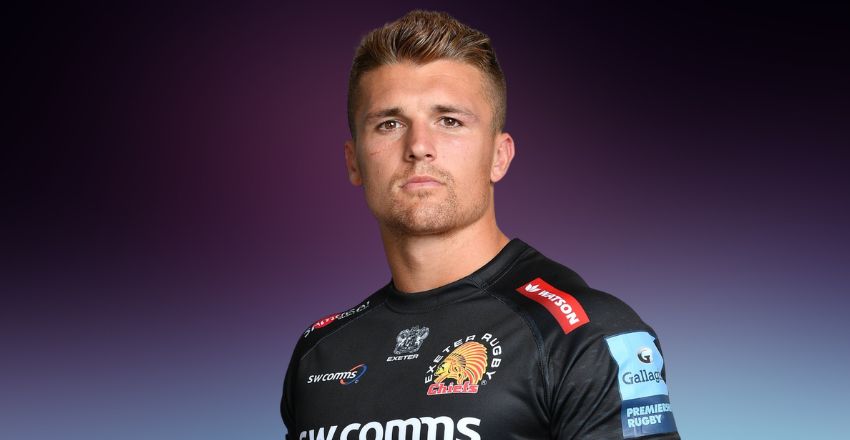
Henry Slade is 33 years old. The England and Exeter Chiefs centre was born on 19 March 1993 in Plymouth, Devon, so he turned 33 in March 2026 and will be 34 in March 2027. A one-club player who came through Exeter’s academy, he made his England debut in 2015, has played at three Rugby World Cups and is known for his left-footed kicking, passing range and defensive reading of the game. He has also played his entire professional career while managing type 1 diabetes.

Henry Slade: quick facts
| Full name | Henry James Slade |
| Date of birth | 19 March 1993 |
| Age | 33 (as of 2026) |
| Birthplace | Plymouth, Devon, England |
| School | Plymouth College |
| Position | Outside or inside centre; has also played fly-half and full-back |
| Club | Exeter Chiefs |
| England debut | 2015 |
| Listed height | About 6 ft 3 in (1.91m) |
| Listed weight | Around 95 to 98kg, varying by source and season |
| Major honours | Premiership and European Champions Cup with Exeter (2020) |
How old is Henry Slade, and how does his age compare?
At 33, Slade is one of the more experienced backs in the England set-up. Many international centres now play well into their early thirties, helped by modern sports science, load management and smarter recovery. Players at this stage often shift from being the dynamic young talent to the organiser of the defensive line and the player who helps younger team-mates settle, and that fits Slade’s reputation as a thoughtful, communicative centre.
For context, he was 22 at his first Rugby World Cup in 2015, 26 at the 2019 tournament in Japan, and 30 at the 2023 World Cup in France. Whether he features at the 2027 tournament in Australia, when he will be 34, will depend on form, fitness and selection.
How long can a rugby centre keep playing?
There is no fixed retirement age in professional rugby, but most backs finish their top-level careers somewhere in their early to mid thirties. Centres face a heavy physical load: they make a large number of tackles, take contact in midfield and have to keep up with quicker wingers and full-backs in wide defence. What tends to extend careers is a mix of good fortune with injuries, smart workload management by clubs and national coaches, and a playing style that relies on decision-making and skill rather than raw pace alone.
That is one reason playmaking centres like Slade often age well. Kicking, passing, positional sense and defensive organisation are skills that improve with experience, while the need for explosive speed matters a little less than it does on the wing. Players in this position often move between inside and outside centre later in their careers, or take on a bigger leadership role in the squad. Whether Slade stays in the England picture as he moves through his thirties will depend on fitness, club form and the emergence of younger centres, but his skill set is the type that typically lasts.
Being a one-club player also brings stability. Staying at Exeter has meant no disruption from moving house or adapting to a new system, and it has made him one of the most recognisable figures in the club’s modern history. For supporters, he is a link between the side that won the 2020 double and the younger squad that has followed.
Early life and education
Slade grew up in Plymouth and attended Plymouth College, an independent school with a strong sporting tradition. He was a talented all-round sportsman as a youngster and came into the Exeter Chiefs academy system in the South West, which has produced a steady line of England internationals. He represented England at age-group level before breaking into the Exeter first team as a teenager.
Club career with Exeter Chiefs
Slade made his senior debut for Exeter around 2012 and has stayed with the club throughout his career, which is increasingly rare in professional rugby. Early on he was often used at fly-half and full-back, before settling in the centres, where his vision and kicking give Exeter a second playmaker outside the number 10.
He was part of the Exeter side that rose from a newly promoted Premiership club to one of the best teams in Europe. The highlight was 2020, when Exeter won both the European Champions Cup and the Premiership, a league and European double. Exeter also reached several other Premiership finals during that era, including winning the title in 2017. Since then, the club has gone through a rebuilding phase with many younger players, and experienced figures like Slade have been central to that transition.
International career with England
Slade won his first England cap in 2015 and was named in the squad for the home Rugby World Cup that autumn. He became a more regular part of the side under Eddie Jones and was in the squad that reached the 2019 World Cup final against South Africa in Japan, where England finished runners-up. At the 2023 World Cup in France, England reached the semi-finals and went on to win the bronze medal match. He has also been part of England’s Six Nations campaigns over many seasons.
| Year | Milestone | Slade’s age |
|---|---|---|
| 2012 (approx.) | Senior debut for Exeter Chiefs | 19 |
| 2015 | England debut and first Rugby World Cup | 22 |
| 2019 | Part of the squad that reaches the Rugby World Cup final in Japan | 26 |
| 2020 | Champions Cup and Premiership double with Exeter | 27 |
| 2023 | Rugby World Cup bronze with England | 30 |
Playing style: what makes him effective
- Left-footed kicking: his long kicking from the centre gives teams another exit and attacking option, and a left-footer adds variety to a backline dominated by right-footed kickers.
- Distribution: he can pass off both hands and often acts as a second playmaker, putting outside backs into space.
- Defence: at outside centre he is often responsible for reading attacks and organising the wide defensive line, a role that relies on communication and decision-making.
- Versatility: experience at fly-half and full-back makes him useful for coaches managing squads and injuries.
Height and weight
Slade is usually listed at about 6 ft 3 in (1.91m) and in the mid to high 90s in kilograms, though official squad profiles vary slightly between seasons. That frame is typical for a modern Test centre: big enough to carry into contact and make dominant tackles, but mobile enough to cover the wide channels.
Playing professional rugby with type 1 diabetes
Slade was diagnosed with type 1 diabetes as a young player, and he has spoken openly about managing the condition during training and matches. Type 1 diabetes means the body does not produce insulin, so blood glucose has to be monitored and insulin taken throughout the day. For an elite athlete, heavy exercise, adrenaline and match-day routines all affect blood sugar, which makes careful planning with medical and nutrition staff essential.
Continuous glucose monitors, which track levels through a small sensor on the skin, have made this far more manageable for athletes in recent years. Slade’s openness has made him a positive example for young people with type 1 diabetes who want to play sport at a high level. Anyone living with the condition should work out their own approach with their diabetes care team, and charities such as Diabetes UK offer practical guidance on exercise and sport.

Personal life
Slade keeps his private life fairly low-key compared with some sports stars. He remains strongly associated with Devon and the South West, having spent his whole career close to where he grew up. Details such as salary and net worth have not been disclosed; Premiership salaries are not published and are subject to the league’s salary cap, so figures found online should be treated as guesses.
If you enjoy rugby profiles, read our guide to Johnny Sexton’s career and net worth, or for another British sporting story see Fabio Wardley’s boxing career. You can find more profiles in our Entertainment section.
Frequently asked questions
How old is Henry Slade?
Henry Slade is 33. He was born on 19 March 1993 in Plymouth, so he turns 34 in March 2027.
What position does Henry Slade play?
He mainly plays centre, usually outside centre, and has also played fly-half and full-back for Exeter and England.
Which club does Henry Slade play for?
He has played his whole professional career for Exeter Chiefs, winning the Premiership and European Champions Cup double with them in 2020.
Does Henry Slade have diabetes?
Yes. He has type 1 diabetes, diagnosed as a young player, and has spoken publicly about managing it while playing elite rugby.
How tall is Henry Slade?
He is usually listed at about 6 ft 3 in (1.91m), with a playing weight in the mid to high 90s in kilograms.
Health information in this article is general and not medical advice.