
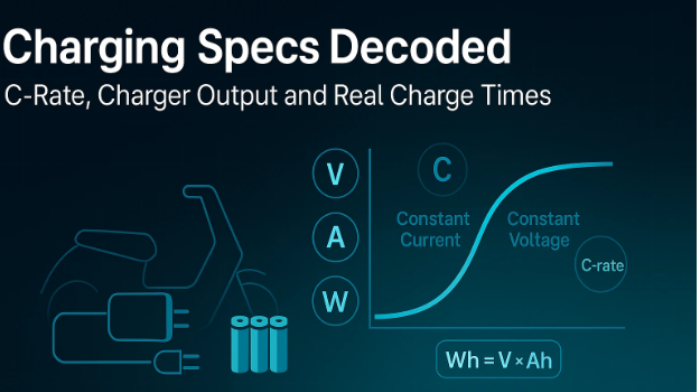

Confused by charging specs on your scooter’s box or charger brick? Voltage, amps, watts, and C-rate can feel abstract, yet they decide how long you wait and how hard your battery works. This guide decodes the numbers so you can estimate real charge times, pick sane settings, and protect pack life. If you want model context later, browse our Reviews and the catalog of Electric Scooters Specifications; for now, use this brand-agnostic playbook to make fast, safe, real-world estimates.
Why Charging Specs Matter
When you understand the numbers, you avoid surprises. Accurate estimates help you plan a commute, a campus day, or an evening ride without range anxiety. They also help you treat the battery kindly, the same pack that charges gently and stays cool lasts longer.
Moreover, reading specs correctly prevents mismatches. A charger with the wrong voltage can damage a pack. An over-ambitious current setting may overheat cells or trigger your BMS to throttle charging. With clarity, you’ll plan around your schedule, extend battery life, and keep your scooter reliable.
The Core Concepts of Charging Specs (Plain English)
Let’s translate the fundamentals into everyday terms.
- Voltage (V)
Think of voltage as electrical “pressure.” A higher voltage pack needs a charger with a higher matching output voltage (the pack’s max/“charge to” voltage, not just its nominal number). - Current (A or amps)
Current is the flow rate. More amps mean faster charging—up to the limits your battery and BMS allow. - Power (W = V × A)
Power is how hard the charger pushes energy into the pack. A 54.6 V, 2 A charger delivers about 109 W (54.6 × 2). - Capacity (Ah / Wh)
Capacity is how much energy your battery holds.- Watt-hours (Wh) measure energy directly.
- Amp-hours (Ah) measure capacity relative to voltage.
You can convert easily:
Wh = V × Ah and Ah = Wh ÷ V.
- C-Rate
C-rate is a dimensionless way to compare charge current to battery size.
C = charge current (A) ÷ battery capacity (Ah).- 0.5C means the charging current equals half the pack’s Ah rating.
- 1C means the charging current equals the pack’s full Ah rating.
A 12 Ah pack at 1C charges at 12 A (if the BMS and cells allow it). Most commuter scooters use ≤1C for longevity.
Together, these values tell you how quickly you can fill the tank and how hard you’re pushing the cells.
Charger Output Explained
Nameplate vs. real output. The label on your charger lists a target voltage (the pack’s full-charge voltage) and a max current. In practice, the charger follows a CC/CV profile:
- Constant Current (CC) phase: The charger holds a fixed current (e.g., 2 A), and the package rises.
- Constant Voltage (CV) phase: Once the pack reaches the set voltage (e.g., 42.0 V for a 36 V nominal NMC pack), the charger holds that voltage and tapers current until the battery is full and balanced.
Because of tapering and small efficiency losses, real-world charge time exceeds the simple “energy ÷ power” math. That’s normal.
Common scooter charger voltages (examples):
42.0 V (10s NMC full charge), 54.6 V (13s NMC), 58.8 V (14s NMC), 67.2 V (16s NMC). LFP packs use different numbers (e.g., ~3.65 V per cell at full charge), so typical full-charge voltages differ for the same “series” count.
Current limitations. Even if you buy a higher-amp charger, your BMS may cap current for safety. The label on the brick isn’t a guarantee—the pack decides what it accepts.
From Spec Sheet to Real Charge Time (Step-by-Step)
You can estimate charge time quickly with a few conversions and a realistic factor.
Core conversions
- Wh = V × Ah
- Ah = Wh ÷ V
Ideal time (hours)
Ideal Time≈Battery WhCharger W\text{Ideal Time} \approx \frac{\text{Battery Wh}}{\text{Charger W}}Ideal Time≈Charger WBattery Wh
where Charger W = Charger V × Charger A (use the charger’s nameplate voltage and current).
Real-world time
Multiply the ideal time by a factor for efficiency + taper:
Real Time≈Ideal Time×(1.15 to 1.30)\text{Real Time} \approx \text{Ideal Time} \times (1.15 \text{ to } 1.30)Real Time≈Ideal Time×(1.15 to 1.30)
- Use ~1.15 for modest currents and partial charges.
- Use ~1.25–1.30 for full charges to 100% or higher currents that cause more taper and heat.
Worked Examples (brand-agnostic)
These are estimates, not promises. Your BMS behavior, temperature, and SOC window matter.
Example A
- Pack: 36 V, 360 Wh
- Charger: 42.0 V, 2 A → ≈ 84 W
- Ideal: 360 Wh ÷ 84 W = 4.29 h
- Real: 4.29 h × 1.20 ≈ 5.15 h
Example B
- Pack: 48 V, 480 Wh
- Charger: 54.6 V, 3 A → ≈ 164 W
- Ideal: 480 Wh ÷ 164 W ≈ 2.93 h
- Real: 2.93 h × 1.20 ≈ 3.52 h
Example C
- Pack: 52 V, 624 Wh
- Charger: 58.8 V, 2 A → ≈ 118 W
- Ideal: 624 Wh ÷ 118 W ≈ 5.29 h
- Real: 5.29 h × 1.25 ≈ 6.61 h
Understanding C-Rate Limits and Battery Health
C-rate summarizes how hard you’re charging relative to pack size.
- Typical safe ranges: Many commuter-class batteries stay in the ~0.5C–1.0C window for longevity.
- Heat matters: Charging generates heat; higher C-rates, hot garages, and direct sun raise cell temperature. Excess heat ages cells faster.
- SOC window: Charging rapidly near full (80–100%) triggers longer CV taper and more heat per minute of energy added.
- Practical takeaway: If time allows, aim for moderate C-rates and avoid long, hot 100% top-offs.
Chemistry Differences (NMC vs LFP, etc.)
NMC / NCA (3.6–3.7 V nominal, 4.2 V full per cell):
- Higher energy density; common in many scooters.
- Noticeable CV taper near the top; 0–80% feels fast, 80–100% slows.
- Good performance across a wide temp range, but heat still shortens life.
LFP (≈ 3.2 V nominal, ≈ 3.65 V full per cell):
- Lower voltage per cell but excellent cycle life and thermal stability.
- Flatter voltage curves during discharge; taper at the top still applies.
- Often comfortable with frequent partial charges and conservative top-offs.
What this means for time:
Chemistry affects full-charge voltage and taper behavior, so two packs with the same Wh can charge at different “feels.” However, the energy ÷ power × factor method still gives a solid estimate across chemistries.
The CC/CV Curve in Practice
Riders often notice that the first 60–70% fills quickly. That’s the CC phase, where current is steady and watts are near the label value. As the battery approaches its maximum voltage, the charger switches to CV and current tapers. Consequently, the final 20–30% can take almost as long as the earlier chunk, especially if the BMS performs balancing.
This is why estimates like “0–80% in two hours” and “80–100% in another hour” can both be true for the same setup. The last few percent simply take patience.
Fast Charging: Pros, Cons, and Myths
Pros
- Shorter pit stops when the day is packed.
- It is useful for shared scooters in a busy household.
- Handy when weather windows are tight.
Cons
- Diminishing returns: Above a point, you pay more heat for fewer minutes saved because the CV phase still slows the top end.
- Connector limits: Thin cables and small connectors drop voltage and generate heat; they also limit safe current.
- Pack stress: Higher C-rate charging, especially to 100% and in summer heat, accelerates aging.
Myths
- “Higher amp = always better.” Not always. If your BMS throttles current or taper dominates the last 20%, a bigger brick won’t save much time.
- “Voltage can be off a bit.” No—voltage must match the pack’s required charge voltage. That’s non-negotiable.
Safety & Care Checklist
- Match voltage exactly to the pack’s required full-charge voltage.
- Use quality chargers with intact cables and snug connectors.
- Charge on a hard, ventilated surface away from flammables.
- Avoid extreme temperatures: Aim for roughly 50–86 °F (10–30 °C) while charging.
- Do not cover the charger; allow airflow.
- Let a hot or cold pack rest to room temperature before charging.
- Follow your manufacturer’s manual for maximum current and allowed chargers.
- Unplug after charging if you don’t need a long float at 100%.
Troubleshooting Real Charge Times
If your clock doesn’t match your math, check these factors:
- Outlet and extension cables: Undersized cords drop voltage and can slow charging.
- Actual charger wattage: Some bricks sag under load; measure with a watt meter if needed.
- Pack temperature: A hot or cold battery charges slower as the BMS protects cells.
- Hidden BMS limits: The pack may cap current below the charger label.
- Starting SOC: A 30% to 100% session takes longer than 10% to 80% at the same watts.
- Parallel loads: Powering lights, dashboards, or accessories while charging reduces net energy into the pack.
- Aging cells: Older packs have higher resistance and spend more time in taper.
Mini “Calculator” Method (No Code)
Use these four steps anytime:
- Collect inputs: Battery Wh, charger V and A (compute W = V × A).
- Computer ideal time: Wh ÷ W.
- Apply factor: Multiply by 1.15–1.30 for taper and losses (use the higher end for 100% charges or higher currents).
- Sanity check: If your estimate seems off, consider temperature, BMS limiting, and where you start and end the charge (e.g., 20%→90% is faster than 0%→100%).
This routine turns charging specs into a dependable, repeatable estimate.
Quick Reference Tables
Table 1: Example Packs & Chargers → Ideal vs Realistic Charge Time
| Pack (Nominal V / Wh) | Charger (V / A ≈ W) | Ideal Time (h) | Realistic Time (h)* |
|---|---|---|---|
| 36 V / 360 Wh | 42.0 V / 2 A ≈ 84 W | 4.29 | ~5.0–5.2 (×1.15–1.20) |
| 48 V / 480 Wh | 54.6 V / 3 A ≈ 164 W | 2.93 | ~3.4–3.7 (×1.15–1.25) |
| 52 V / 624 Wh | 58.8 V / 2 A ≈ 118 W | 5.29 | ~6.1–6.9 (×1.15–1.30) |
| 60 V / 720 Wh | 67.2 V / 3 A ≈ 202 W | 3.56 | ~4.1–4.6 (×1.15–1.30) |
*Realistic times assume room-temp charging and a full charge to 100%. Partial charges (e.g., to ~80–90%) trend closer to the lower end.
Table 2: C-Rate Cheat Sheet (Implied Current Limits)
| Battery Capacity (Ah) | 0.5C (A) | 0.8C (A) | 1.0C (A) |
|---|---|---|---|
| 7.5 Ah | 3.8 | 6.0 | 7.5 |
| 10 Ah | 5.0 | 8.0 | 10.0 |
| 12 Ah | 6.0 | 9.6 | 12.0 |
| 15 Ah | 7.5 | 12.0 | 15.0 |
| 20 Ah | 10.0 | 16.0 | 20.0 |
Always verify with your scooter’s manual and BMS limits. C-rate is a guide, not a permission slip.
Best Practices That Extend Battery Life
- Favor partial charges when time allows; cycling between ~20% and 80–90% is kinder than full 0–100% swings.
- Dial back current on hot days or when the battery feels warm.
- Top off slowly before storage; if parking for weeks, store around 40–60% SOC in a cool, dry place.
- Balance occasionally: A full, gentle charge to 100% helps cell balancing—do it periodically, not daily.
- Keep connectors clean and tight to reduce resistance and heat.
FAQs
Q1. Is it safe to leave the scooter on the charger overnight?
Often the BMS stops charging at full and the LED turns green. However, extended time at 100% isn’t ideal daily. If you must charge overnight, ensure good ventilation and avoid stacking items on the charger. When convenient, unplug after reaching your target SOC.
Q2. Can I use a higher-amp charger if the voltage matches?
Sometimes. Voltage must match exactly. Then confirm the max charge current your battery/BMS allows. If the BMS caps current, a larger-amp brick won’t speed things up.
Q3. Is 80% better than 100% for daily use?
Yes, for longevity. The final 10–20% adds more stress and takes longer due to CV taper. Save full 100% charges for long rides or periodic balancing.
Q4. What if my charger’s voltage is slightly different from the pack’s required full voltage?
Don’t use it. Over-voltage risks damage. Under-voltage may never complete charging and can confuse the BMS.
Q5. Do travel chargers make sense?
Yes. A compact, lower-watt charger runs cooler and is gentle on the pack. It’s slower but great for workplace or classroom top-ups.
Q6. Why does charging slow down near the end?
That’s the CV phase. The charger holds constant voltage and reduces current to avoid overcharging. Balancing also lengthens the last few percent.
Q7. How do temperature and seasons affect charge time?
Cold cells accept current more slowly, and hot packs trigger protective limits. Aim for 50–86 °F (10–30 °C) while charging and let extreme-temp packs rest first.
Q8. Where can I get “charging specs decoded” in one place?
Use the quick steps in this guide: compute Wh, find W, divide, and apply the taper factor. Then adjust for temperature and where you start/finish.
Glossary (Plain English)
- Ah (Amp-hour): Battery capacity measured as current × hours.
- Wh (Watt-hour): Total energy; voltage × amp-hours.
- C-Rate: Charge current divided by battery capacity (A ÷ Ah).
- CC/CV: Constant Current then Constant Voltage charging profile.
- BMS (Battery Management System): Protects cells, manages current, balances voltages.
- SOC (State of Charge): How full the battery is (0–100%).
- DOD (Depth of Discharge): How much of the battery you’ve used.
- Taper: The current reduction during the CV phase near full.
- Nominal Voltage: The average operating voltage per cell or pack (not full).
- Max (Charge) Voltage: The upper limit per cell/pack that the charger targets.
- Charge Window: The SOC range you plan to charge through (e.g., 30%→90%).
- Cycle: One full 0–100% equivalent usage; two 50% charges = one cycle.
- IR (Internal Resistance): The pack’s resistance; higher IR means more heat and slower charging.
- Thermal Runaway: Dangerous, uncontrolled temperature rise—avoid with proper voltage, quality parts, and ventilation.
- Balancing: BMS equalizes cell voltages, often during the last part of charging.
Final Notes
You don’t need a lab to make solid estimates. With charging specs, a calculator, and common-sense safety, you can plan your day accurately and keep your battery healthy. When in doubt, prioritize a cooler, slower top-off and reserve fast charging for the times it truly saves your schedule.