
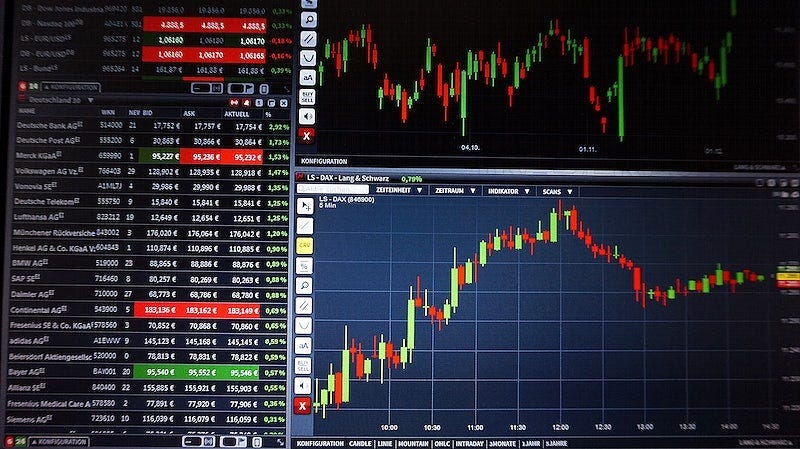

The financial industry is undergoing a digital revolution, with technology transforming the way individuals and institutions invest, trade, and manage capital. Among the most impactful innovations are AI trading platform and Quantum AI, both of which are reshaping the dynamics of global markets. By integrating advanced data analytics, predictive algorithms, and real-time decision-making, these technologies offer traders unparalleled advantages.
In this article, we explore how AI-powered trading platforms work, the unique potential of Quantum AI, and what they mean for investors worldwide.
Understanding AI Trading Platforms
What is an AI Trading Platform?
An AI trading platform is a digital system powered by artificial intelligence that enables investors to trade stocks, cryptocurrencies, forex, and commodities with minimal human intervention. These platforms rely on sophisticated algorithms and machine learning to analyze massive datasets, identify profitable opportunities, and execute trades within seconds.
Unlike traditional trading software, AI platforms adapt to changing market conditions, continuously learning from past trades and improving strategies over time.
Key Features of AI Trading Platforms
- Real-Time Market Analysis – AI systems process enormous volumes of financial data, including news feeds, market sentiment, and historical patterns, providing investors with timely insights.
- Automated Trading Execution – Orders are placed automatically based on pre-set strategies, eliminating human delays and emotions from trading decisions.
- Risk Management Tools – AI platforms often integrate stop-loss mechanisms, portfolio rebalancing, and predictive analytics to minimize risks.
- Accessibility – Many platforms are designed for both professionals and beginners, offering user-friendly dashboards and customizable trading parameters.
Benefits of AI Trading
- Speed and Accuracy: AI eliminates delays in trade execution.
- Emotion-Free Decisions: Unlike humans, AI does not suffer from fear or greed.
- Continuous Monitoring: Markets operate 24/7, and AI ensures no opportunities are missed.
- Data-Driven Insights: Traders benefit from predictive analytics and in-depth market research.
The Rise of Quantum AI
What is Quantum AI?
Quantum AI is a fusion of quantum computing and artificial intelligence, applied to financial trading and investment strategies. Quantum computers operate differently from classical computers, using quantum bits (qubits) that can represent multiple states simultaneously. This allows them to perform complex calculations at unprecedented speeds.
When combined with AI, this technology can analyze countless trading variables, simulate market outcomes, and develop strategies that outperform conventional systems.
Why Quantum AI Matters in Trading
- Massive Data Processing – Financial markets generate terabytes of data daily. Quantum AI processes this data exponentially faster than classical AI.
- Complex Pattern Recognition – Quantum algorithms can detect subtle correlations across markets that are invisible to traditional tools.
- Enhanced Predictive Power – By simulating thousands of scenarios, Quantum AI increases the accuracy of market forecasts.
- Optimization of Portfolios – Investors can achieve better diversification and risk-adjusted returns using quantum-optimized strategies.
Potential Applications in Finance
- High-Frequency Trading (HFT) – Executing trades within milliseconds for maximum profitability.
- Cryptocurrency Markets – Navigating highly volatile crypto environments with quantum-level precision.
- Derivatives and Risk Management – Identifying and hedging against complex market risks.
- Global Portfolio Management – Providing real-time solutions for multi-asset, multi-market strategies.
Comparing AI Trading Platforms and Quantum AI
While both AI trading platforms and Quantum AI aim to enhance investment performance, they differ in complexity and capability.
| Feature | AI Trading Platforms | Quantum AI |
|---|---|---|
| Technology | Machine Learning, Predictive Algorithms | Quantum Computing + AI |
| Speed | Fast, but limited by classical hardware | Exponentially faster with qubits |
| Accessibility | Widely available to retail and institutional investors | Emerging technology, limited access |
| Application | Stocks, forex, crypto, commodities | Advanced portfolio optimization, HFT, crypto |
| Cost | Affordable subscription models | Currently high, but expected to drop over time |
In short, AI trading platforms are the present, while Quantum AI represents the future of trading.
How AI and Quantum AI Enhance Trading Strategies
Automated Decision-Making
AI and Quantum AI enable fully automated trading, where buy and sell decisions are made without human interference. This ensures trade is executed at optimal times, reducing the risk of missed opportunities.
Advanced Risk Management
- AI uses historical data to predict downturns.
- Quantum AI simulates multiple possible market futures, providing deeper risk insights.
Together, they help investors protect capital and maximize gains.
Personalization and Adaptive Learning
AI trading platforms can adapt to individual investor profiles, tailoring strategies to risk tolerance, financial goals, and asset preferences. Quantum AI enhances this personalization by testing countless strategies simultaneously.
Real-World Use Cases
AI Trading Platforms in Action
- Crypto Trading Bots: Widely used to monitor volatile markets and execute trades automatically.
- Stock Market Applications: Hedge funds and retail investors use AI for predictive stock selection.
- Forex Trading: AI platforms analyze macroeconomic indicators and sentiment to anticipate currency movements.
Quantum AI Experiments
Although still in development, several financial institutions are testing Quantum AI applications:
- JPMorgan Chase and Goldman Sachs are exploring quantum computing for risk analysis.
- Google Quantum AI has conducted simulations with potential applications in portfolio optimization.
- Startups are developing Quantum AI trading bots tailored to cryptocurrencies.
Challenges and Considerations
For AI Trading Platforms
- Market Volatility – AI systems may struggle during unpredictable events like geopolitical crises.
- Overfitting Risks – Algorithms may perform well in simulations but poorly in real-world conditions.
- Dependence on Data Quality – Biased or incomplete data can lead to flawed strategies.
For Quantum AI
- High Costs – Quantum computing infrastructure is expensive.
- Limited Access – Only large corporations and research institutions currently utilize quantum systems.
- Regulatory Concerns – As with AI, ensuring compliance and transparency in trading is a key challenge.
The Future of AI and Quantum AI in Trading
The convergence of AI and quantum computing is expected to transform the financial industry over the next decade. Predictions include:
- Mass Adoption of AI Trading Platforms among retail investors.
- Quantum AI Integration in Hedge Funds, allowing unprecedented speed and profitability.
- Global Accessibility as costs drop and cloud-based services offer Quantum AI tools to smaller investors.
- Regulatory Frameworks ensuring ethical use of AI and quantum systems in financial markets.
Conclusion
The rise of AI trading platforms and Quantum AI marks a turning point in the history of finance. AI platforms already provide investors with real-time insights, automated execution, and improved risk management. Meanwhile, Quantum AI promises exponential advances in data processing, predictive analytics, and portfolio optimization.
For today’s investors, AI trading platforms offer practical tools to stay competitive in volatile markets. Looking ahead, as Quantum AI matures, it will unlock new levels of accuracy and profitability, redefining the very foundations of global trading.
In a world where speed, precision, and data-driven strategies determine success, embracing AI and preparing for the coming wave of Quantum AI is no longer essential optionality.